Farmers stand firm: New rally for the arrested – Next steps announced

Farmers across Greece are calling Sunday’s mass demonstrations a “first victory,” despite the police’s intense use of force. They have set a new gathering for Monday morning at the Larissa courthouse, demanding the release of their detained colleagues and sending a strong political message to the government.
Serious clashes marked the first day of the farmers’ mobilizations, with three livestock farmers arrested and brought before the prosecutor. At 10:30 a.m. on Monday, farmers from the Nikaia blockade plan to gather outside the Larissa Police Directorate, insisting on the release of their colleagues. Charges are expected to be announced under the summary “in flagrante” procedure.
According to onlarissa.gr, among the detained is a young livestock farmer who recently lost 1,000 sheep to a month-long outbreak of sheep pox.
SYRIZA MP for Larissa, Vasilis Kokkalis, who is legally representing the detained farmer, condemned the police violence as “unnecessary,” adding: “The government is unfortunately criminalizing the legitimate and absolutely necessary protest of farmers and livestock breeders. Today’s police violence was uncalled for. The government must engage in dialogue, not beat farmers. The charges against the detainees are excessive and unfounded.”
Major blockades across the country
Since Sunday afternoon, Greece has effectively been split in two, as farmers gathered near the Nikaia junction and proceeded to block the Athens–Thessaloniki National Highway.
More than 800 tractors are positioned at the two main blockades, with another assembly scheduled for Monday afternoon.
In Central Macedonia, another blockade is expected in Eastern Thessaloniki, near Malgara. Farmers have already gathered in the town square and plan to reach the Malgara toll station around 10 a.m.
For now, they do not intend to block the road again, though farmers may move from Epanomi–Halkidiki toward the airport junction known as “Prasina Fanaria,” depending on developments.
Tractors and riot police face off
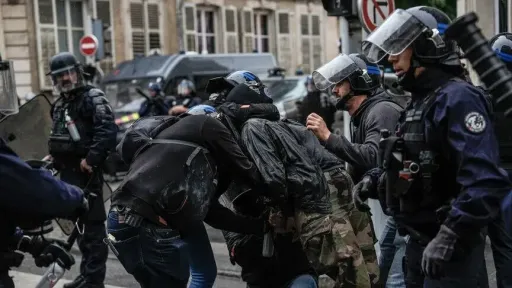
On Sunday, despite heavy police repression—including tear gas, flash bangs, and baton charges—farmers and livestock breeders from Larissa, Farsala, Tyrnavos, Elassona, and Magnesia fully blocked both directions of the national highway near Larissa.
Two farmers were injured in Nikaia and Platikampos. Agricultural union leader Mr. Sidiropoulos reported that he was struck by police officers.
Earlier in Nikaia, police had positioned two riot-control buses to block the road and prevent farmers from advancing. However, some agricultural vehicles had already moved onto the road before the clashes began, and farmers eventually broke the police line and reached the highway using side roads.
The farmers insist they will not back down. “Our struggle has just begun,” they said from the Nikaia blockade. “This was our first victory against police forces, tear gas, and batons. But it won’t be the last—our fight will continue for many days.”
Blockades nationwide until 5 December
Farmers, livestock breeders, and beekeepers in Karditsa are also mobilizing on a large scale. For the first time, they managed to block the Central Greece Highway using agricultural machinery.
A major blockade has formed in Alexandria, Imathia, with further developments expected in Chalkidona. Mobilizations nationwide are scheduled to continue until 5 December.
Rows of tractors have also assembled at the 4th kilometer of the Gümülcine/İskeçe (Komotini–Xanthi) ring road. Since Sunday morning, farmers from villages across the Rhodope region have brought their tractors to the site, though no roads have been blocked yet.
“We can’t take it anymore!”
There is widespread anger, as thousands of farmers and producers have remained unpaid for months. “We can’t take it anymore,” they tell the government, citing severe delays in basic subsidies, compensations, and support payments—especially those tied to CAP programs and weather-related damages—which have pushed them into financial suffocation.
They stress that rising prices for fuel, fertilizers, and animal feed have worsened the situation, leaving many farms struggling for survival due to a lack of liquidity.