World Cup victory overshadowed by online racist abuse

The observatory, which operates under Spain's Ministry of Inclusion, Social Security and Migration, said it detected 40,861 pieces of online content linked to hate speech and discriminatory narratives in June.
Sport accounted for 16% of the monitored content, making it the second-largest driver of online hate after public insecurity, which represented 69% of detected material.
Yamal becomes focal point
OBERAXE said the World Cup generated a significant wave of racist and Islamophobic messages directed at national teams, supporters and players, with Barcelona and Spain winger Lamine Yamal among the most prominent targets.
Born in Spain, Yamal has a Moroccan father and an Equatorial Guinean mother. The observatory said his background became the focus of discriminatory comments circulating on social media throughout the tournament.
The player also found himself at the center of public debate after former Spanish Prime Minister Mariano Rajoy described France's national team as a side "without French people" following Spain's victory over Belgium.
Asked about the remarks before Spain's semifinal against France, Yamal rejected the controversy.
"If football serves any purpose, it is to integrate, at the level of society," he said, describing both Spain and France as examples of successful social integration.
Days before the World Cup final, fresh controversy erupted after an Argentine journalist referred to Yamal by highlighting his Moroccan heritage, prompting criticism in Spain.
According to OBERAXE, people of North African origin were targeted in 88% of the hateful content analyzed, up 10 percentage points from May.
Hate speech becomes more aggressive
The observatory said nearly half of the monitored content dehumanized or seriously degraded targeted groups, representing a 25-percentage-point increase compared with the previous month.
Around 32% of the messages portrayed migrants or minority groups as a threat, 10% called for their expulsion, while 6% encouraged violence. Another 3% praised attacks against targeted groups.
The report found that 89% of the content used openly hostile language, including insults, threats and derogatory remarks, while 10% relied on irony or sarcasm to spread discriminatory messages.
Images, videos, memes and coded language appeared in 32% of the recorded content, making moderation more difficult, OBERAXE said.
Platforms show mixed response
Overall, 61% of the content reported by OBERAXE was removed by digital platforms, down from 65% in May.
TikTok recorded the highest removal rate at 98%, followed by X at 93%, Facebook at 62%, Instagram at 32%, and YouTube at 8%.
The observatory also found that reports submitted through its "trusted flagger" mechanism resulted in a 51% removal rate, compared with 10% for content reported by individual users, highlighting the effectiveness of specialized reporting channels.
AI-generated disinformation adds challenge
The World Cup was also marked by the spread of manipulated and AI-generated content targeting Yamal.
Among the false material identified was an AI-generated video falsely claiming that Spanish broadcaster Canal 24 Horas had reported an investigation into the player over "radical Islamism."
Other fabricated posts sought to associate Yamal with religious symbols or practices, illustrating how manipulated visual content is increasingly being used to amplify discriminatory narratives.
Football mirrors wider social tensions
Beyond football, OBERAXE said hate speech was also linked to debates over migration, public policy and public security.
Content related to public policies accounted for 11% of the monitored material, while messages concerning sexual assault represented 9%. Posts linked to terrorism and migrant boat arrivals accounted for 3% and 2%, respectively.
The observatory said many posts falsely associated migrants with crime, insecurity and social disorder through misleading or decontextualized information.
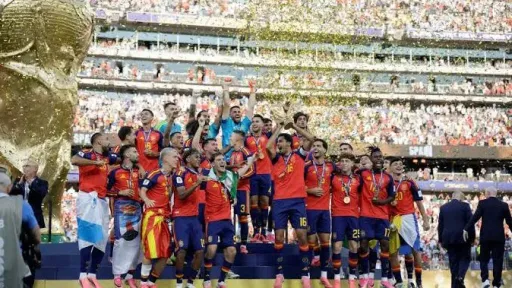
According to OBERAXE, Spain's World Cup victory became both a moment of national celebration and a reminder of persistent divisions over identity, migration and religion, with Yamal emerging as both a symbol of integration and a frequent target of online racist and Islamophobic abuse.
Source:AA