Naim Süleymanoğlu: The man who lifted the world
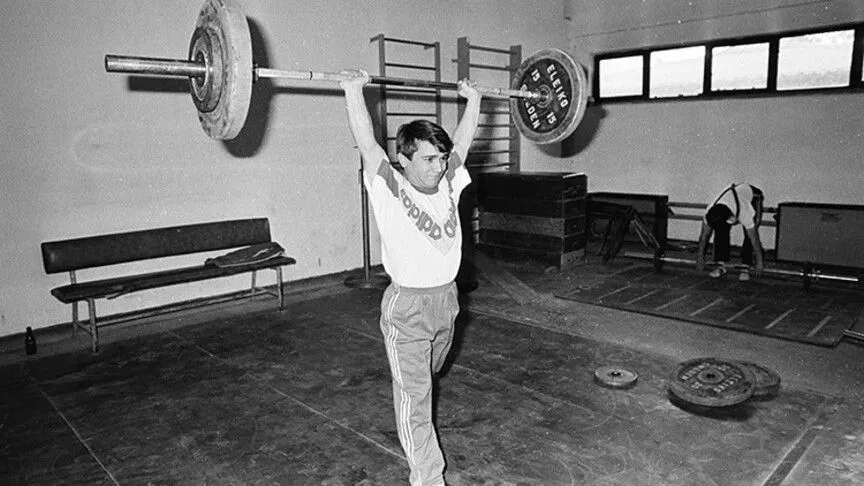
Nine years after his death, legendary weightlifter Naim Süleymanoğlu remains one of the most influential figures in Turkish and world sporting history, having won three consecutive Olympic gold medals and seven world and seven European titles.
Naim Süleymanoğlu, widely known as the “Pocket Hercules”, was born on 23 January 1967 in the village of Ahatlı, in the Kardzhali region of Bulgaria. One of the greatest weightlifters in the history of the sport, he made an enduring mark on international athletics with his extraordinary achievements.
Recalling how he first took up weightlifting, Süleymanoğlu once said:
“When I was nine, my weightlifting coach, Hilmi (Pekünlü), discovered me, and that is how I started weightlifting. At the time, Bulgaria was producing world and Olympic champions, and I wanted to become a champion too.”
Beyond his sporting achievements, Süleymanoğlu became an internationally recognised figure for drawing attention to the persecution of ethnic Turks in Bulgaria.
At the age of 14, he won Bulgarian junior and youth championships. A year later, in 1982, he claimed his first world title at the World Junior Weightlifting Championships in Brazil, becoming the youngest world record holder in the sport.
He won the senior World Weightlifting Championships in 1983. Between 1983 and 1986, he broke 13 junior and 50 senior records. He was also named Weightlifter of the Year in 1984, 1985 and 1986.
After breaking a world record at the Tournament of the Champions in the United States in 1983, he was given the nickname “Pocket Hercules” by the American press.
Süleymanoğlu was unable to compete at the 1984 Los Angeles Olympics after Bulgaria joined the Soviet-led boycott of the Games.
In 1984, he also made history by becoming the second weightlifter to lift three times his own body weight in the clean and jerk.
HIS NAME WAS CHANGED, AND HE FLED TO TÜRKİYE
As part of the Bulgarian communist government's so-called “Revival Process”, which sought to assimilate the country's Turkish minority, Turkish names were banned and Süleymanoğlu's name was changed to Naum Shalamanov.
He later described his escape to Türkiye as an effort to draw international attention to the persecution of Turks in Bulgaria and help bring it to an end. At the time, ethnic Turks were subjected to a systematic campaign of assimilation.
Reflecting on his decision to seek refuge in Türkiye, Süleymanoğlu said:
“I could not accept the persecution of Turks. I did not want to sweat for those who denied the existence of Turks. I was going to seek asylum in Türkiye. By February 1986, the names of all Turks had been changed. My name was now Naum Shalamanov. I won the World Weightlifting Championships held in Melbourne, Australia, in 1986. At the dinner held after the championships on 10 December 1986, I met people who would take me to the Turkish Consulate.”
In 1986, Süleymanoğlu sought asylum at the Turkish Embassy in Australia. Following a carefully coordinated operation, he travelled by plane from Australia to London and was then brought to Türkiye on a special aircraft sent by then-Prime Minister Turgut Özal.
He received a jubilant welcome in Ankara, where he addressed the Turkish public for the first time at a press conference.
To enable him to represent Türkiye at the 1988 Seoul Olympics, the Turkish government paid Bulgaria $1 million.
From that point onwards, Süleymanoğlu competed for Türkiye. Former President Turgut Özal later remarked on the payment: “Naim repaid us many times over. He promoted Turks to the world.”
His escape also brought international attention to the persecution of ethnic Turks in Bulgaria, including restrictions on circumcision, imprisonment for those who underwent the practice and the destruction of graves because of the Turkish names inscribed on tombstones.
THREE CONSECUTIVE OLYMPIC GOLD MEDALS
Süleymanoğlu cemented his place among the world's greatest athletes at the 1988 Seoul Olympics in South Korea. Competing in the men's 60-kilogram category, he won the gold medal while setting six world records and nine Olympic records.
He lifted 190 kilograms in the clean and jerk – more than three times his body weight – and received the award for the world's best weightlifter. He became the only athlete to achieve this feat.
He also lifted 152.5 kilograms in the snatch, bringing his combined total to 342.5 kilograms and setting further world and Olympic records.
With this victory, Süleymanoğlu became the first Turkish athlete outside wrestling to win an Olympic gold medal.
In 1992, the International Weightlifting Press Commission named him the world's best athlete.
He went on to win Olympic gold medals at the 1988 Seoul, 1992 Barcelona and 1996 Atlanta Games, becoming a three-time consecutive Olympic champion. Throughout his career, he also won seven world and seven European titles and set 46 world records.
After taking a break from weightlifting in 1996, Süleymanoğlu returned to compete at the 2000 Sydney Olympics but was unsuccessful. He subsequently retired from professional sport. Until the Sydney Games, he had remained one of the leading figures in international weightlifting for 24 years.
THE FIRST TURKISH ATHLETE TO APPEAR ON THE COVER OF TIME
Following his record-breaking performance at the 1988 Seoul Olympics, Süleymanoğlu appeared on the cover of Time magazine on 3 October 1988, under the headline “Everybody Wins”.
That same year, following the European Weightlifting Championships, he was invited to the White House by then-US President Ronald Reagan. He declined an offer of US citizenship.
In 2000, Süleymanoğlu became the youngest vice-president in the history of the International Weightlifting Federation (IWF).
During the 2012 London Olympics, a station on the London Underground was named after him. In 2018, Ankara Metropolitan Municipality also named a street in the Çankaya district in his honour.
THE FILM THAT TOLD HIS STORY: “POCKET HERCULES: NAIM SÜLEYMANOĞLU”
The life of the legendary weightlifter was brought to the big screen in Pocket Hercules: Naim Süleymanoğlu, directed by Özer Feyzioğlu and written by Barış Pirhasan.
The screenplay drew on the book My Brother, Pocket Hercules (Kardeşim Cep Herkülü), which contains the memories of Süleymanoğlu's brother, Muharrem Süleymanoğlu. The film was released on 22 November 2019.
It follows Süleymanoğlu's journey from his introduction to weightlifting as a 10-year-old in the 1970s through to his triumph at the 1988 Seoul Olympics.
The legendary Turkish weightlifter died on 18 November 2017, aged 50, from liver failure while receiving treatment in hospital. He had been admitted on 28 September 2017. President Recep Tayyip Erdoğan, who had closely followed his treatment, visited him in hospital on 9 October 2017.
His funeral prayer was held at Fatih Mosque in Istanbul on 19 November 2017. Numerous figures from politics, business and sport attended, including Greek weightlifter Valerios Leonidis, his greatest rival during his competitive career.
Naim Süleymanoğlu was laid to rest at Edirnekapı Cemetery nine years ago, leaving behind a legacy that transcended sport and became part of the history of Turks in the Balkans.