Anti-Muslim racism has entered Europe’s political mainstream, Farid Hafez says

Researcher Farid Hafez says anti-Muslim racism has worsened over the past decade, becoming increasingly embedded in everyday politics and institutions across parts of Europe, while elements of the far right’s anti-Muslim agenda have been adopted by mainstream parties.
Dr. Farid Hafez, a sociology lecturer at the University of Limerick in Ireland and a senior researcher at Georgetown University’s Bridge Initiative, has warned that anti-Muslim racism in Europe has become increasingly normalized over the past decade.
Speaking to Anadolu Agency as part of its series on discrimination in Europe, Hafez said the situation had deteriorated since the publication of the first European Islamophobia Report in 2015. He co-edits the annual report with Enes Bayraklı, head of the Department of Political Science and International Relations at Turkish-German University.
Hafez said awareness of anti-Muslim racism had increased in some parts of Europe, but argued that efforts to address it remained limited compared with what he described as the deeper institutionalization of Islamophobia.
MAINSTREAM PARTIES HAVE ADOPTED PARTS OF THE FAR RIGHT’S DISCOURSE
According to Hafez, anti-Muslim positions that were predominantly associated with far-right parties when the European Islamophobia Report was first published have increasingly appeared in the political mainstream.
He pointed to Denmark, where he said Social Democrats had adopted elements of such positions, as well as developments in other countries involving conservative parties.
Hafez also cited Germany and France as examples of a wider political polarization. In Germany, he contrasted political developments in Berlin with an electoral victory by the far-right Alternative for Germany (AfD) in an eastern state. He said a similar urban-rural divide could be observed in France.
More broadly, Hafez argued that mainstream center-right and center-left parties had adopted some elements of anti-Muslim discourse, although he said they often framed them differently from the far right — including through arguments centered on secularism or Christian and Judeo-Christian values.
His assessment reflects his broader research on Islamophobia in Europe. In a March 2026 analysis marking a decade of the European Islamophobia Report, Hafez wrote that Islamophobia remained widely unrecognized and was frequently denied or minimized by governments, political parties, institutions and public commentators across Europe.
EUROPEAN RESPONSE REMAINS UNEVEN
Hafez also criticized what he described as limited institutional responses to anti-Muslim racism at the European level.
He noted that the United Nations has designated March 15 as the International Day to Combat Islamophobia, while arguing that recognition and resources at the European level remain insufficient.
Hafez pointed to the European Commission’s Coordinator on combating anti-Muslim hatred and discrimination but argued that the position has limited resources and powers compared with some other EU-level coordinator roles.
He also cited Germany’s collection of data on anti-Muslim hate crimes and Norway’s national action plan against anti-Muslim racism as examples of institutional measures. At the local level, he said European cities seeking to address Islamophobia have also established cooperation networks.
SECURITY POLICIES REMAIN A KEY AREA OF CONCERN
According to Hafez, the security sector represents one of the most difficult areas in efforts to combat anti-Muslim discrimination.
He argued that independent Muslim organizations and activities in several European countries have increasingly been viewed through a security lens, particularly when they have links to countries outside Europe.
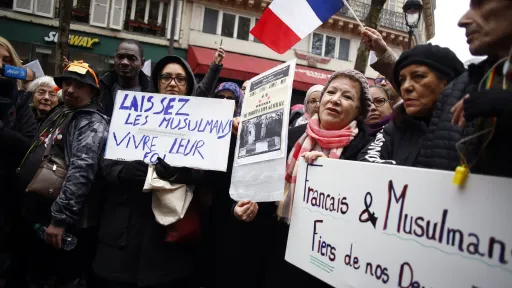
Hafez singled out France as an example, referring to the closure of Muslim associations and the seizure of their assets under counterterrorism legislation and measures commonly associated with the country’s anti-“separatism” framework.
He argued that the expansion of security-focused approaches has directed increasing resources toward this area while potentially restricting legitimate Muslim civil society activity.
HAFEZ CALLS FOR GREATER POLITICAL ORGANIZATION
Hafez said political change would require pressure from within Muslim communities themselves.
He argued that Muslims should become more politically organized and use different channels — including existing political parties or new political formations — to increase their influence.
He also suggested that Muslim-majority countries could play different roles, including through diplomatic relations, although he acknowledged that some have supported far-right political actors for their own interests.
Hafez’s assessment comes as the European Islamophobia Report marks a decade of monitoring anti-Muslim racism across the continent. The project began in 2014 and has since brought together researchers covering more than 25 European countries.