Bosnia leaders clash over sovereignty and Dayton agreement ahead of anniversary

Presidency chairwoman criticizes international intervention, saying imposed decisions have altered the 1995 peace settlement.
Bosnia and Herzegovina's Defense Minister Zukan Helez on Friday rejected proposals to divide the country along ethnic lines, urging Serbia's newly elected political leadership to respect Bosnia's sovereignty and territorial integrity.
Helez condemned remarks by Serbian academic Kosta Cavoski, a member of the Serbian Academy of Sciences and Arts, who proposed that Republika Srpska declare independence and eventually unite with Serbia, while predominantly Croat areas join Croatia.
Cavoski also questioned Bosnia's future under its current political structure and called for the closure of the Office of the High Representative (OHR), which oversees civilian implementation of the Dayton Peace Agreement.
Helez described the proposals as attempts to undermine Bosnia's statehood, stressing that the country remained committed to preserving its territorial integrity.
Cavoski's comments reflect his personal political position and do not represent an official proposal by Serbian authorities.
Call for better relations with Serbia
Helez also urged Serbia's election-winning Student List to pursue a different approach to relations with Bosnia following its victory in the October 25 parliamentary elections.
He said improved bilateral relations must be based on mutual respect, equality and full recognition of both countries' sovereignty and territorial integrity.
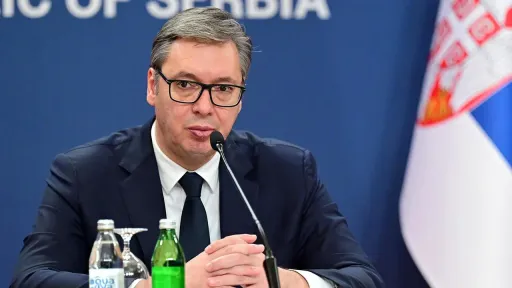
Helez also criticised former Serbian President Aleksandar Vucic, accusing him of interference in Bosnia's internal affairs and repeating allegations linking him to wartime sniper attacks on civilians. Vucic has previously denied the accusations.
Cvijanovic criticizes international oversight
Separately, Bosnia's Presidency Chairwoman Zeljka Cvijanovic criticised international intervention in implementing the Dayton Peace Agreement, arguing that externally imposed decisions had undermined its original framework.
Speaking in Banja Luka, Cvijanovic said the country's persistent political disagreements demonstrated how far implementation had departed from the principles agreed in 1995.
She argued that the agreement established a decentralised system with two entities enjoying extensive autonomy, but said subsequent international interventions had altered its original arrangements.
Cvijanovic also questioned the expanded powers of the international high representative, which include imposing decisions and removing officials under the so-called Bonn powers endorsed in 1997.
These powers remain controversial, with Republika Srpska leaders opposing international intervention, while supporters argue that it is necessary to safeguard the peace agreement and the functioning of state institutions.
Dayton agreement marks 31 years

The statements came ahead of the 31st anniversary of the Dayton Peace Agreement, initialled on November 21, 1995, in Dayton, Ohio, and formally signed in Paris on December 14.
The agreement ended the 1992-1995 Bosnian war and established the country's current constitutional structure, comprising the Federation of Bosnia and Herzegovina and Republika Srpska.
The latest remarks highlight continuing disagreements over Bosnia's constitutional arrangements, international oversight and relations with Serbia, more than three decades after the peace agreement.
Source:AA