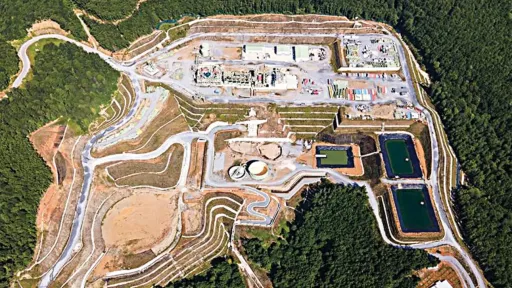
Eastern Macedonia and Thrace regional council unanimously opposes Rozino gold mining project

The Regional Council of Eastern Macedonia and Thrace (AMTH) has unanimously rejected the Environmental Impact Assessment (EIA) for the proposed Rozino polymetallic mining project in Bulgaria, citing serious deficiencies in the submitted studies and potentially severe cross-border environmental consequences for Greece.
The decision was taken on Monday, August 24, following concerns raised by regional authorities, the Technical Chamber of Greece’s Thrace Department (TEE Thrace) and the Inter-County Committee of Rhodope and Meriç against gold mining.
The proposed mine is located in the municipality of Ivaylovgrad in Bulgaria’s Haskovo region, between tributaries of the Byala Reka River. The waterway eventually flows into the Luda River, known in Greece as the Erythropotamos.
The deposit is approximately 11.6 kilometres from the Greek border in the Rhodope regional unit and 19.4 kilometres from the Meriç regional unit, near the point where the Erythropotamos enters Greece.
Authorities warn of major gaps in environmental assessment
The regional authority’s assessment took into account comments submitted by Greece’s Ministry of Environment and Energy (YPEN) to the Bulgarian side, as well as the responses provided by Bulgaria.
According to the regional service, however, the responses did not address all of the issues raised by the ministry, including requests for additional analyses, studies and quantitative assessments.
Officials also highlighted limitations in available data concerning the hydrogeological conditions and water quality, issues that could have significant cross-border implications.
Particular concerns were raised over the planned mining-waste storage facility. The assessment reportedly does not include adequate seismic, structural or dam-break studies.
The authorities also pointed to the presence of naturally occurring arsenic, mercury and radioactive uranium in rocks surrounding the mining area, warning that disturbance of these materials could increase risks associated with water runoff or airborne dust.
The location of the waste-storage facility within the natural basin of Yuren Dere was also considered insufficiently justified from an environmental perspective.
Another major concern is the lack of a detailed assessment showing how potential waste flows could spread, including maps identifying areas in Greece that could be affected in the event of an accident.
TEE Thrace maintains opposition to the project
TEE Thrace President Polyzois Paraskevaopoulos presented the findings of a technical working group established to examine the project. The group’s conclusions had been unanimously approved by the chamber’s Administrative Committee.
The assessment identified significant technical deficiencies in the EIA, as well as management and metallurgical gaps and a lack of adequate safety and structural studies.
Particular concerns focused on the planned tailings dam and the absence of sufficient studies regarding its safety.
TEE Thrace also expressed reservations about assurances from the company that the processing of the ore to extract gold using cyanide would take place at another facility in Krumovgrad rather than at the Rozino site.
Greek and Bulgarian communities raise concerns
The Inter-County Committee of Rhodope and Meriç also spoke against the project during the council meeting.
Committee representative Anestis Stratiadis described visits to the Bulgarian mining area and highlighted what he said were high concentrations of arsenic in local rock formations.
The committee also participated in a public consultation in Ivaylovgrad, where, according to Stratiadis, many participants expressed opposition to the mine and raised concerns over potential contamination of the Erythropotamos River.
The committee said opposition has emerged on both sides of the border, including from academics and municipal councils in Didymoteicho, Orestiada and Soufli.
At the same time, the mining company has reportedly sought to gain local support by promising around 250 jobs in an economically disadvantaged area facing significant demographic decline. Opponents argue that residents remain concerned about protecting the area, which includes Natura-protected territory.
Regional council calls project a potential environmental threat
All political groups represented on the Regional Council expressed opposition to the project.
Some councillors described the proposed mine as a potential “geochemical bomb,” particularly because of the presence of arsenic, while warning that possible impacts could extend beyond the Meriç regional unit to groundwater resources in Rhodope.
Regional authorities also argued that the project does not fit the development model of Eastern Macedonia and Thrace.
Regional Governor Christodoulos Topsidis said the regional administration would remain open to further cooperation with municipalities and other local bodies. He also said that legal action before European institutions could be considered if necessary to prevent the project from going ahead.
“We must defend our area and the EMTH region,” Topsidis said, adding that authorities would continue monitoring developments and could bring the issue back before the Regional Council if necessary.