Advisory Board rejects mufti appointments, says minority's will cannot be ignored
The Advisory Board of the Turkish Minority of Western Thrace has rejected the recent appointments to the mufti offices in Komotini (Gümülcine) and Xanthi (İskeçe), calling on the Greek government to resolve the longstanding dispute through dialogue and respect for the minority's free will.
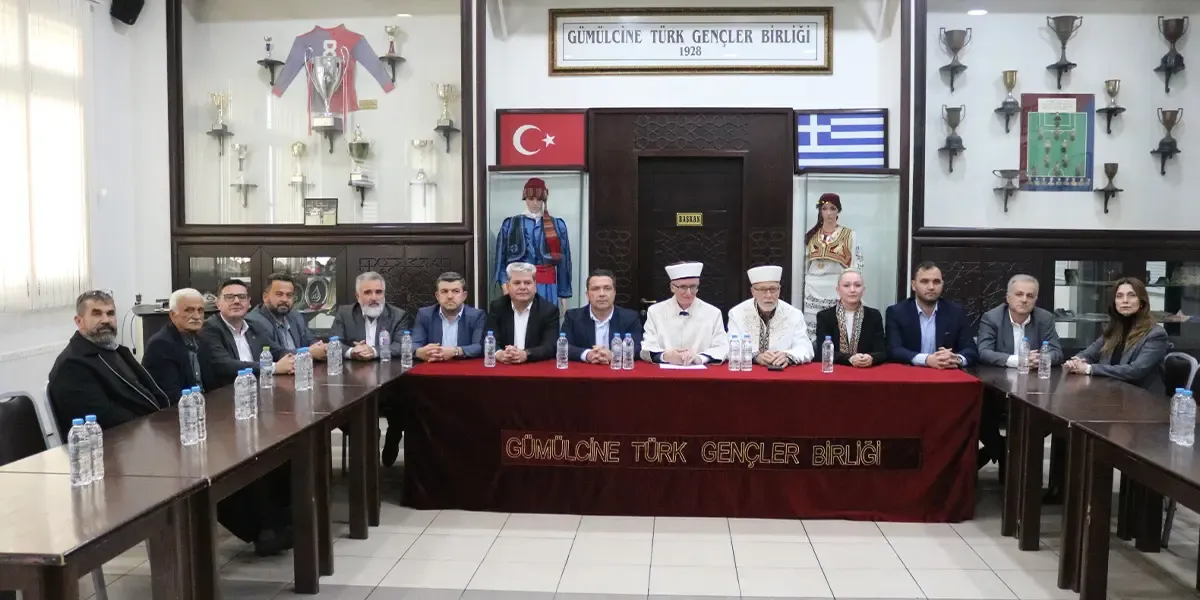
The Board's chairman, Mustafa Trampa, who also serves as the Mufti of Xanthi (İskeçe), made the remarks during a press conference held on Monday, 2 November, at the Komotini Turkish Youth Union (GTGB).
The meeting was attended by Trampa, Ibrahim Serif, the Mufti of Komotini (Gümülcine), representatives of the Turkish minority and members of the media.
Reading a statement on behalf of the Advisory Board, Trampa described the mufti issue as one of the longstanding unresolved problems facing the Turkish Minority of Western Thrace and criticised the Greek government's latest appointments to the mufti offices in Komotini and Xanthi.
MINORITY CALLS FOR RIGHT TO CHOOSE ITS MUFTIS
Trampa stressed that the minority's demand to freely determine its religious leaders was not new, describing it as a fundamental issue of rights and representation that had continued since 1985.
Despite more than four decades having passed, Greece had yet to establish what he described as a lasting and fair solution to the dispute.
He argued that appointments made by the state without taking the minority's will into account represented a continuation of a unilateral approach.
Trampa reiterated that the Turkish Minority of Western Thrace recognises Ibrahim Serif as its Mufti of Komotini and Mustafa Trampa as its Mufti of Xanthi, adding that appointing individuals whom the minority does not recognise disregards the community's collective will.
'APPOINTMENTS CANNOT CREATE SOCIAL LEGITIMACY'
The Advisory Board's statement emphasised that although the state could fill official positions through appointments, such decisions alone could not establish social acceptance or legitimacy.
Trampa also argued that the selection committee formed without the minority's views or participation could not confer legitimacy on the appointments in the eyes of the community.
He said a genuine solution would only be possible if the minority's own will were placed at the centre of the process.
According to the statement, the dispute is not merely an administrative matter or a question concerning official positions. It is directly connected to the minority's religious identity, freedom of belief and right to determine its own religious leadership.
ADVISORY BOARD URGES GREECE TO INITIATE DIALOGUE
Trampa criticised the Greek government's approach to issues directly affecting the minority, saying that unilateral decisions continued to be taken instead of engaging in meaningful dialogue with minority institutions and representatives.
He argued that this approach had failed to resolve the dispute and had instead weakened trust between the state and the minority.
On behalf of the Advisory Board, Trampa explicitly condemned and rejected the latest appointments to the mufti offices in Komotini and Xanthi.
He called on the Greek government to launch a genuine, constructive and results-oriented dialogue with the minority's institutions and representatives.
BOARD CITES INTERNATIONAL TREATIES AND MINORITY RIGHTS
The statement also addressed the historical and legal dimensions of the mufti dispute.
It referred to Article 11 of the 1913 Treaty of Athens, which, according to the Board, provides for muftis to be elected by Muslim voters within their respective jurisdictions.
The Advisory Board also highlighted the 1923 Treaty of Lausanne as a fundamental international agreement safeguarding the status and religious rights of the Turkish Minority of Western Thrace.
Trampa maintained that the mufti issue was closely linked to minority rights and religious autonomy established under international treaties. He argued that continuing with appointments that disregard the minority's will was incompatible with the relevant international legal framework.
The Board called on Greece to respect its obligations under international treaties and resolve the dispute through a dialogue process based on the minority's free will and consistent with international law.
'WE DEFEND DIALOGUE, NOT IMPOSITION'
Concluding the statement, Trampa stressed that the social acceptance of religious leaders was essential to peaceful coexistence.
"We defend dialogue, not imposition; consultation, not unilateral decisions; and respect for the will of the community, not its disregard," he said.
The Advisory Board chairman reaffirmed that the body would continue to pursue the minority's demand for the right to determine its own religious leaders.