Turkish language marks 749th year as official state language
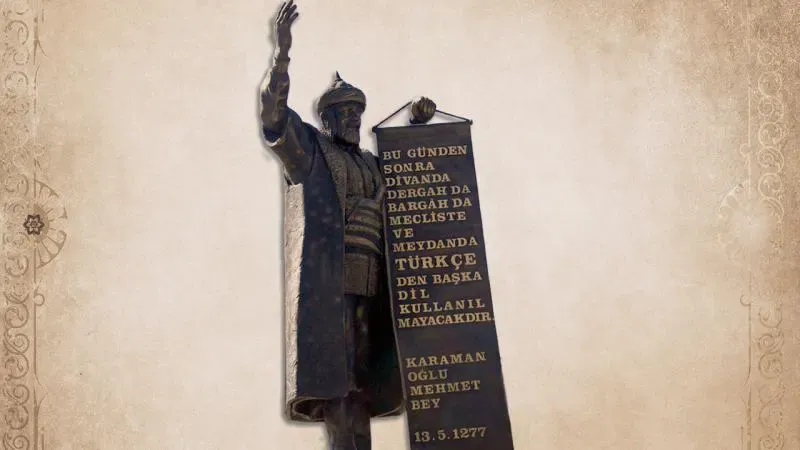
Türkiye is marking the 749th anniversary of the declaration of Turkish as an official state language, commemorated annually on May 13 as “Turkish Language Day.”
The milestone dates back to May 13, 1277, when Karamanoğlu Mehmet Bey issued a decree stating: “From now on, no one shall speak any language other than Turkish in the court, council, assemblies and public places.”
The decree marked the first official recognition of Turkish as a state language, strengthening its status at a time when Arabic and Persian dominated administration and literature.
Events highlight importance of Turkish
Commemorative events are being held in Karaman, Ermenek and the village of Balkusan to honor Karamanoğlu Mehmet Bey and highlight the importance of preserving the Turkish language and culture.
Turkish is considered one of the world’s oldest languages and is currently ranked as the sixth most spoken language globally. It is also among the top five most widely learned foreign languages.
More than 200 million people speak Turkish across a vast geography stretching from the Balkans and Northern Cyprus to the Turkic republics, Iraq and Syria.
Turkish expanded across regions
From the 13th century onward, Turkish continued developing in cultural centers across Khwarezm, the Golden Horde, Egypt and Syria.
In the 15th century, prominent Turkic poet and thinker Ali Şir Nevai defended the richness of Turkish in his work “Muhakemetü’l-Lugateyn,” challenging claims that Persian was superior as a literary language.
In Anatolia, Turkish became a written language roughly two centuries after Turkic migrations into the region. The modern written form of Turkish is based on Oghuz Turkish.
Yunus Emre and Ottoman influence
Yunus Emre is regarded as one of the founders of written Turkish literature in Anatolia, helping shape the language through poetry and prose.
Turkish later spread widely during the Ottoman Empire, becoming a language used across the Balkans, Anatolia and North Africa.
Ottoman rulers and statesmen also attached importance to literature and the Turkish language. Historical accounts note that Sultan Murad II supported efforts to simplify literary language and promote clearer Turkish usage.
Language reform and modern Turkish
Language simplification efforts gained momentum during the 19th-century Tanzimat reform era, as intellectuals sought to make written language more accessible to the public.
Today, Turkish continues to serve as a language of education, science, media and literature not only in Türkiye but also across the Balkans, Cyprus, Turkic republics, Iraq and Syria.
Source:TRT