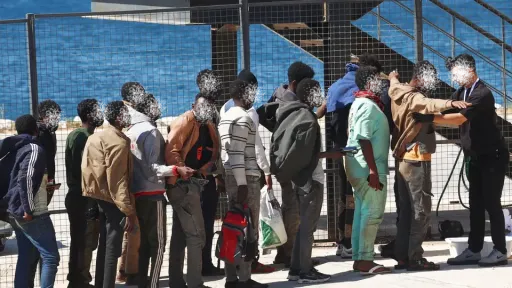
Britain and France renew Channel migration pact with 766 million euro deal

Britain and France have agreed a new three-year pact to curb irregular crossings of the English Channel, with London committing up to 766 million euros in funding and Paris pledging to deploy nearly 1,400 law enforcement officers on its northern coastline, according to a French interior ministry roadmap obtained by AFP.
The agreement renews the Sandhurst treaty, a bilateral security framework that has governed joint Channel migration efforts since it was first signed in 2018 and extended in 2023, and which was set to expire this year. Months of negotiations preceded the deal, with Britain insisting that any renewal include enforceable conditions on how its taxpayers' money is spent by the French government.
Performance conditions attached to a quarter of the funding
Under the terms of the new arrangement, nearly a quarter of the British funding comes with strings attached, to be released only if French measures demonstrate tangible results. According to the interior ministry roadmap, if the agreed measures fail to deliver "sufficient results, based on a joint annual assessment, the funding will be redirected to new actions."
That accountability mechanism reflects longstanding British frustration with the pace of French enforcement. London has for years accused Paris of doing too little to prevent would-be asylum seekers, smugglers and migrants from departing French shores, often on overcrowded or unseaworthy vessels. The issue has remained a persistently sensitive one in British domestic politics.
France, for its part, pledged to increase coastal law enforcement by more than half from current levels, reaching 1,400 officers by 2029. Beyond personnel, the plan calls for expanded use of drones, helicopters and digital surveillance tools to "better prevent attempted crossings" and reduce departures, with particular focus on so-called "taxi boats" used to evade detection by authorities.
A legal barrier at the waterline
The new measures are shaped in part by a fundamental constraint of maritime law: once a vessel leaves shore, authorities may only intervene to rescue people from drowning, not to turn them back. That provision of international law of the sea has compelled both governments to focus their enforcement efforts on preventing departures before they happen, rather than intercepting boats mid-crossing.
The Sandhurst treaty framework, which builds on earlier bilateral arrangements including the 1991 Sangatte Protocol and the 2003 Le Touquet Treaty, established a legal architecture for broad cooperation on border and migration issues. Since 2019, its focus has shifted almost entirely to small boat crossings, which have become the predominant method of irregular arrival in the United Kingdom.
Crossings remain near record levels
The backdrop to the deal is a crossing count that remains stubbornly high. Official British figures show 41,472 people arrived irregularly by small boat in 2025, the second-highest annual total since large-scale crossings were first detected in 2018. At least 29 migrants died in the Channel that same year, according to an AFP tally compiled from official French and British sources.
Smuggling networks have adapted over time to avoid interception, taking escalating risks that have pushed migrants into increasingly dangerous conditions on the water. The new agreement, with its emphasis on surveillance technology and a larger coastal law enforcement presence, is designed to disrupt those networks before boats reach open water, where the legal options available to authorities narrow sharply.
turkiyetoday